Monday, June 20, 2016

The Legend of Zelda: Evolution of a Virtual World


I may be a Millennial, but that doesn't necessarily mean that I'm on top of everything when it comes to technology. That category. of course, includes video games. I was born in 1987, so I  grew around that amazing, magical time, where gaming exploded in popularity during the now legendary Console Wars of the '90's between Nintendo and Sega.

Every kid on my street had a console or a computer, and we were all playing games at least some of the time. I think my parents bought me an NES  when I was 5 because they assumed that was what I wanted. Honestly, it's hard not to blame them. I barely played on my NES though, either because the  blocky sprites were too crude or the gameplay was too confusing to hook me in like so many other kids.

My relationship with games have taken a few turns over the years. The first console I can remember actually wanting (and begging, lots and lots of begging) was the Playstation. I had never seen anything like it. It still amazes me how time can make you look back and think "was I ever really impressed by games like that"? Try explaining to kids born around 2000 or later, that the crude polygon models of the PS was cutting-edge once upon a time.

Indeed, games and gamer culture has evolved so much so fast, that my outlook has changed just as drastically, if not as quickly. Of course, I don't need to tell most of you this.

But for me, for a few years, I really didn't play games that much, so all these changes going on escaped my notice. I would play on my best friend's N64 & Xbox whenever I came over to visit, but outside of a few RTS classics like Warcraft 3 or playing with my little brother on my (now ancient) dependable SNES well  into the 2000s.

 Of course, I wouldn't be writing about the Zelda franchise if I still didn't care about video games. On the contrary, I have been left in awe but how far games have come since my childhood. Every trailer, every game demo, presents me with sound, visuals, emotion and depth, that I could not see coming all those years ago.

Zelda, among a few select other franchises like Mario, Metal Gear Solid or Final Fantasy, have stayed as relevant as they have ever been to the industry they help shape. The fact that these titles have stayed relevant over decades of incredibly fast change, where developers are constantly innovating and giving gamers around the world new experiences, new worlds, new hardware, new stories, is truly remarkable. You really need to see it to truly get what I'm saying. Just compare the original Legend of Zelda released 30 years ago in 1986:


To, for example, The Legend of Zelda: Ocarina of Time, at the time of its release one of the greatest and innovative games of it's time (and according to many, still is) released just 12 years later in 1998:


Now of course you can see the differences between these two games because the jump from to 2D to 3D is a pretty drastic change. The next game in the series Twilight Princess, doesn't look much different but still pretty impressive, and this game was released just eight years after OoT, in 2006:


Now,  here's what The newest Legend of Zelda game, titled The Breath of the Wild, has in store for us in 2017. If the other trailers looked good to you, get ready for an awe-inspiring 3 minutes.


Amazing,  isn't it? Here's where it gets truly mind-boggling for me. The latest Zelda game is being released on two consoles, the Wii U and Nintendo's newest console, for now codenamed "NX" due to be released next March alongside the game. Neither of these systems are cutting edge; a pretty safe statement to make, even though we currently know very little is  about Nintendo's latest hardware.

The way consoles are released, is that the designers and company must strike a balance between affordability and improving the performance of the hardware significantly. If consoles were truly made with top-tier parts, they would cost anywhere from $1000-2000. So what you buy for $500 dollars is a mid-level system at best, that will be obsolete in about 5-6 years. In the Wii U's case, it's a good system but there's no denying that it is significantly less powerful than the PS4 and the Xbox One.

With that out of the way, think about this. What you saw in the above trailer was made to work on older hardware. Yet, the game still undeniably looks next-gen. I can't even image what the next Zelda game will look like, and technically speaking the "current game" isn't even out yet!

I'm sure you've noticed a lot of interesting things in the trailer, but I'm also sure a lot of you are wondering exactly what the big deal is. Sure, it's big and it looks pretty, but why exactly am I gushing so much about this game.

Well, there's good news. During the E3 convention held in June of this year, Nintendo released a lot of gameplay footage. I mean,  A LOT of gameplay footage. Most developers will only show you demos lasting around around maybe 10-20 minutes, sometimes half an hour, to give you a sense of the gameplay, the world that the developers created, the characters and of course, other things like the shiny new graphics engine and improved AI.

According to one member of the popular gaming forum NeoGAF, the Nintendo Treehouse livestream event showed off 5 HOURS of total footage of this game. Journalists for the video game news site IGN have at least an hour and a half of archived gameplay on their Youtube channel, which I'm sure is being dissected by millions of fans as we speak.

These two sites are my main sources of info about the game. I haven't played any of this. Heck, I haven't even played a Zelda game in years. But I can still give everyone a solid breakdown of the game, and show you how it reflects a lot of the major changes in the video game inditry as whole, as well as being a major change for the franchise itself.

Scope and Detail

When any game is made on more powerful hardware, and especially since this is the first "true HD" Zelda game in the franchise, the developers have a lot more sophisticated tools to bring Hyrule to life and more importantly, have more space to fill up to make the world feel immersive and give the player a lot of things to do. It shouldn't surprise anyone that the game is bigger and looks better.

The game is still staggeringly huge. According to the game's producer Eiji Aonuma, Breath of the Wild is twelve times the size of Twilight Princess which at the time it was released, was considered the best game in the series. He went on to say that the starting area players saw in the gameplay demo, known in the game itself "The Great Plateau", is just one percent of the final game. I watched people playing constantly for almost a full hour, and I saw an almost non-stop barrage of new things presented. This one area has everything: beautiful fields of tall grass, a waterfall, a small snow-capped mountain, and a few shrines place around the area filled with secrets and puzzles. I also saw very little backtracking or repetition. This game definitely does not lack for content.

To be fair, there are several games I've played in the past that offer almost as much gameplay as this. Super Mario World and Crash Bandicoot immediately spring to mind. But that doesn't take away the fact that this game was a massive undertaking and risk for the BIg "N".

The size of the game is complemented by lots of little touches that add to the fun and immersion.

For example, when you stand in a field, you see the grass bending in the wind, and the world around you gets slowly darker or brighter because the game has a day/night cycle; with the sun and the clouds moving quickly across the sky. But where older games would just add effects like this into a game to show off the capabilities of the graphics engine and make the world feel  more ral, the wind and the time of day have a significant affect on how you play.

To give one example. if you set a small patch of dry grass on fire and a breeze happens to pick up just then, the fire will spread rapidly around the area, just like it would in real life.

Link has been given a stamina meter to make you time your moves better. While some players don't like this much realism is a game, considering that you have to stop running every ten seconds or so to "catch your breath", it adds another layer of strategy that you have to take into consideration.

Another interesting change is how climate affects you now. In previous Zelda games all you had to do was pick which outfit to put Link in that you felt suited him best. In this game, you can't go into an arctic tundra in just a tunic, or a desert wearing heavy clothing, otherwise Link will take damage. So the clothes now has a practical purpose

Breath of the Wild is hardly the first game to add this sort of complexity. In fact, several fans have already complained that it's borrowing too much from successful RPG franchises like Mass Effect and Elder Scrolls. No one is saying that making the world more detailed or adding more space and complexity is in itself a bad thing, but some Zelda fans don't want the series to change too drastically from they are familiar with.

Now, from my perspective as an admittedly non-fan of the series, all the changes I've described so far add a lot of layered strategy, choice and difficulty to the game. You can now set enemies on fire, roll a boulder down a hill, attack at night when the bad guys are asleep etc. Of course, previous Zelda games offered a wide variety of items to use or places to go. This one us just adding more to keep gameplay and exploration from becoming stale.

From what I can tell, it still feels like Zelda. Sure you have to gather and cook food to replenish health instead of going to a random patch of tall grass and start swinging away randomly with your sword, but the new doesn't doesn't seem much more time-consuming or difficult to me.


Gameplay and Content

Pack a lunch, because this section might take awhile. Since gameplay and content are two of the biggest things video game developers are constantly challenging themselves to expand on year after year, needless to say, there is a lot to do in Breath of the Wild. The franchise has taken pages out of a whole shelf of other books for this game.

You don't find hearts just lying in random breakable pots or patches of grass anymore. Much like games that add more realism to how you replenish health like Far Cry  you hunt and forage for food, and even cook it over a campfire to recharge your health or cook up an elixir that will make you temporarily stronger, faster, or temporarily make you immune to the elements.

As I said before, the time of day and the weather will affect how you play. You might want to wait for enemies to fall asleep, or avoid fighting the stronger enemies that wake up at night. If a thunderstorm should break out while you're running around, be wary of getting struck by lightning if you're still carrying that awesome sword on your back.

Weapons seem plentiful in this game. You can take them from enemies in a pinch, or you can wonder around, looking for a pitchfork or ax someone left lying around for young kleptomaniacal heroes like yourself to find.

Of course, there are temples, shops and hidden areas that have special items and gear, but if you don't want to go through hurdles to get all the fancy stuff, you can collect any old tree branch lying around on the ground, build a fire, set the branch on fire. and now you can set your enemies ablaze with your new, homemade firebrand.

There's been a lot of changes, some major some minor, that makes the combat interesting and fun, All the weapons and shields are breakable, so you have to keep track of how much punishment you've dealt out or received from enemies.  You can also slide on top of your shield too, whether it be on grass or on a snowy hillside. Finally, a video game that let's you pull off a Legolas maneuver!

When you dodge an enemy's attack at just the right time, Link will enter a "bullet time" state, like in the Max Payne series, where the enemies are basically frozen or move in slo-mo for a few seconds, allowing to finish them off in style.

You don't have to fight your enemies directly. Roll a boulder down a hill, fire a fire arrow into an exploding barrel, plant a bomb where they usually patrol around and detonate it remotely, or shoot arrows from the back of your faithful horse Epona as she runs circles around them. Who says you have to fight at all? You're perfectly free to avoid enemies as well, especially if they are much stronger than you.

Unlike previous Zelda games, you are given a lot more options to fight or to avoid fighting, I haven't even talked about the magic system or the awesome items you can get, like the Fire Rod, but I think we've talked enough about combat.

The magical abilities have a lot to offer outside of outside of combat. Link has access to a new tool in this game, known as the "Sheikah Slate", which is basically a Hyrulean type of tablet computer that runs on magic. By finding and inscribing different mystical runes onto the tablet, Link can gain access to a wide scope of powers.

Dotted throughout the landscape are shrines which act as "mini-dungeons", areas of the game where you solve puzzles and get through obstacles in order to get some new powerful item or skill, or if you just want to explore as much of the world as possible. By using the runes, Link is able to to move around the shrines a lot easier. One rune for example, allows him to freeze time around an object, holding it in place for Link to either manipulate it, or just avoid it altogether. There re also larger temples, where the larger set pieces and boss fights take place, and where presumably you uncover the story of the game.

The runes are just another layer on top of an already impressively deep and complex gameplay system. And remember, everything I've described is from the opening area of the game. This post would've turned into a thesis paper if I had access to the full game right now. You will be pleased to know that this post is nearly done. Just one last thing to talk about.


Going Back to the Roots and Breaking From Tradition

Whenever an iconic franchise gets a new addition, obviously there is a lot of anticipation and dread from fans. The above header shows just how hard it is to please them sometimes. If it is too different from what fans expect, then they will complain that it's not a "true Zelda game"; if it's too similar to previous games, fans will accuse Nintendo of resting on their laurels (a not unfounded accusation) and not doing enough to innovate to give fans something different.

Here's the truly crazy, paradoxical thing about this game, though. It is undeniably a different Zelda game. It has taken a lot from other non-Zelda games. Just look at all the comparisons I've made throughout this post; that is no accident. But do know what the biggest influence was on the design of this game? The original Legend of Zelda. Try to wrap your mind around that one; and after I've been constantly praising this game for all the changes it provides!

In the very first game, players had a lot more freedom to do what they wanted. You didn't have to complete the dungeons in a specific order, or gather the pieces of the Tri-Force as quickly as possible to defeat Ganondorf. You could go in any direction, explore the levels the way you felt was right

So players get the freedom they used to have, with a lot more to do and lot more ways to do it, thanks  to decades of innovations in hardware and game design. Let's be completely fair here though; innovation is always what has kept the fans coming back to the world for more, and stay loyal to this series.

Yes, every game is about a hero named Link, who has to save a Princess named Zelda and save a world called Hyrule, by gathering the pieces of the Tri-Force to defeat the evil wizard Ganondorf . The core ideas of this world and these characters have always remained the same. But anyone can see that Link, Zelda and Hyrule, are very different than from where they started.

 The series has changed A LOT over the years.

The third game of the series, A Link to the Past  introduced, among other things: the Hook Shot, the Master Sword, heart pieces & containers, a new combat system where Link could slash side to side instead of just forward, arrows as collectible ammo, the concept of travelling between two worlds (in this game's case, a "Light" and "Dark" World), and a fairy companion for Link.

All these innovations have been around for so long now, that only older or die-hard Zelda fans would know that all these "classic" Zelda elements were not there at the very beginning. So, it seems to me, that the developers should be given due credit and encouragement to shake things up from game to game. It doesn't seem to have hurt the series' success in anyway.

It's even built into well-known Zelda lore. Each Link, each Zelda, each Ganondorf, are literal re-incarnations of the same people, finding themselves on the same world, in different eras, or, since OoT involves time travel, alternate timelines, Change and stability are reflected in every aspect of this world, it seems. It also gives the developers a very clever excuse to change and to keep what they want.

I am very glad than fans are so enthusiastic about this game so far, because this will help Nintendo keep Zelda (and Mario and Donkey Kong and Star Fox and...well, you get the idea) going for another 30 years and more. The fact that the series has managed to stay so relevant in an industry that changes so fast, is a great accomplishment in and of itself, let alone that many of the individual games are classics in their own right. I don't know how exactly, but the people at Nintendo keep refining what works while adding changes that, in retrospect,  seems to constantly improve on the formula. If only everyone else could do that so consistently. There would be a lot less crappy and infuriating reboots out there.

Happy 30th anniversary Link & Zelda. Happy 30th Ganondorf.  Happy 30th Hyrule.

From where I'm sitting, you've never looked better.


Thursday, June 2, 2016

A Tribute to Sir Terry Pratchett and The Discworld Series


If I was as good a writer as the late great Terry Pratchett, I could have come up with a better opening to this post.

If I were a far worse writer than the late great Mr. Pratchett, I would probably start with something like this:


"Mr. Terrence "Terry" Pratchett was a very funny and talented writer, who wrote a very popular bunch of fantasy books known as the Discworld series. Sadly he passed away on March 12th, 2015 at the age of 66,  finally succumbing to Alzheimer's disease , which he was diagnosed with in 2008. There are 41 Discworld books in total, and thanks to them, Mr. Pratchett was knighted  in 1998 for 'services to literature'. He is survived by his daughter, video game writer Rhianna Pratchett"

This is not going to be a biographical sketch or an obituary. So the "tribute" part of the title is a bit misleading. This post is more of an analysis of a man's writing style and a reflection on his legacy.

Praktische Informatie

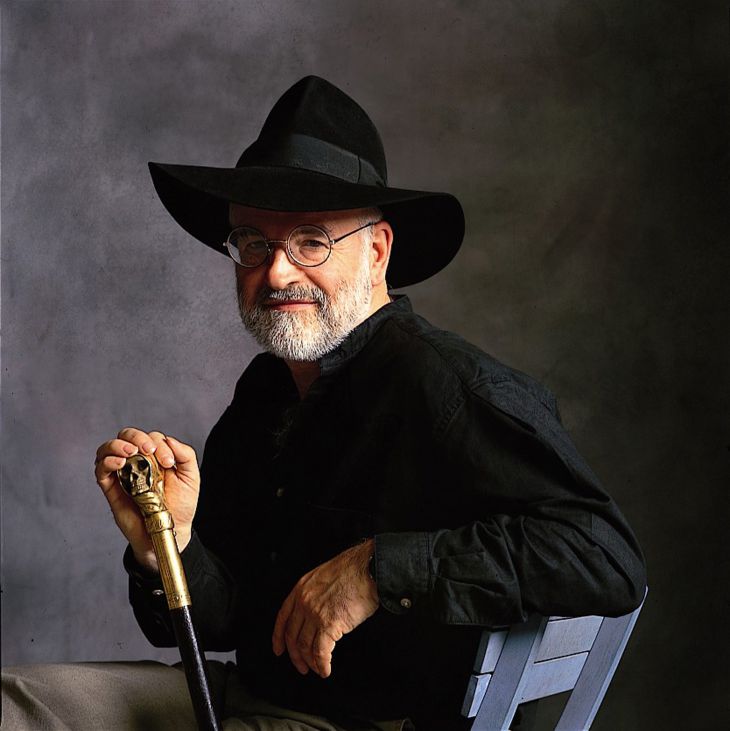
The Man. With His Hat.

The Discworld series is by far his most famous work. It's the only books of his that I've read. Well, besides Good Omens, which he co-wrote with his best friend (and fellow badass writer) Neil Gaiman. It's so similar in style and tone to the Discworld novels that it's practically the "unofficial" 42nd book in the series.

Heck, considering that the Discworld's magic constantly warps and bends space and time, it may very well be part of the canon, and I just don't know it yet. I'll have to look it up later.

Anyway, what exactly is the Discworld series? What's the deal here?

OK, the best way I can describe the series is like this. Imagine one of the writers on The Simpsons (the classic season 1-10 era of the show) was a big fantasy fan. I'm not talking about J.K. Rowling or Supernatural modern urban fantasy. I mean the real old school stuff. Tolkien, Robert E. Howard, H.P. Lovecraft and Fritz Leiber just to name a few. Three of the books in the series are basically parodies of Shakespeare, but Pratchett was a British humorist; he was, for all intents and purposes, required to poke fun at The Bard at some point.

So saying this is a fantasy version of the Simpsons feels both an appropriate comparison and a disservice to Pratchett's skill. For one thing, the first book in the series, The Color of Magic, was published in 1983. So it's not like he was really ripping off the show's style of humor. For another, there's a lot of references only a British audience would get. Not to say that Pratchett didn't have a broad appeal, but, well...how do I put this? There's a long running joke in the series about Morris dancing, just to give you an idea of how obscure he can be.  If I didn't have access to a fan website that compiled and explained all the references in the series, I would've been way more confused when I started reading these books.

It's also not fair to call these books the fantasy version of Hitchhiker's Guide to the Galaxy either. Not helping matters is that both men held similar views on certain things. I think it is safe to say that, they were two men born around the same time who happened to be very funny British atheists. I mean, it's very easy to compare and contrast, but I doubt their similarities to each other is nothing more than a happy coincidence.

So getting back on track. The Discworld was (and is) for the most part, a parody of a wide variety fantasy stories and cliches. But sometime around book four in the series (Mort), Pratchett began to broaden out the themes and topics he would tackle in the flat (yet somehow still three-dimensional) world which he had created.

 It's easy to compare the Discworld books to The Simpsons, because there is a large cast of characters and places residing on the Disc. and through them, Pratchett would make fun of humanity's flaws and foibles, as well as modern society as he added more  changes to the setting over the years. Pratchett would eventually tackle topics ranging from slavery, racism and war, to the cult status of modern celebrites, what makes a hero a hero, and even what it means to be mortal and knowing that someday you will cease to exist, This a lot of heavy and heady stuff, but Pratchett took all this subject matter on with tongue firmly in cheek and a smile on his lips at all times (presumably). He was one of those rare writers who could make you laugh and pause to think on the sentence you had just read that had made you laugh.

To give just one of many, many examples, here's a paragraph from the opening page of Lords and Ladies, the 14th book in the series:

"The curtain goes up, the first pawn is moved, the first shot is fired-but that's not the start. The play, the game, the war is just a little window on a ribbon of events that may extend back thousands of years.The point is, there is always something before."

In the beginning of the book. Mr. Pratchett makes the reader stop and look at the word  "beginning". It's not really THE beginning of course, but we still use the word anyway to describe stories that always start "in medias res". It one paragraph, he's made us think about not just the quirks of the English language, but also the limited way humans view Time. Pretty damn impressive. if you ask me.

It's not all philosophy and social commentary. There is plenty of witty dialogue, references by the ton, scores of larger than life personalities, some pretty creepy scares, and a bit of cartoonish slapstick thrown in for seasoning. Take away the commentary and the humanist philosophizing though, and you take out a lot of the  heart and brains (and maybe a kidney)  of Pratchett's world. There is a reason why the Discworld is called "a world and mirror of worlds" many times in the series by the author. Like any writer, he makes us able to see ourselves more clearly. Like any good writer, he does it in a very clever and subtle way.

Lords and Ladies is a great example of Pratchett's strengths as a writer.

On one level it's a parody of A Midsummer Night's Dream. There's even an important plot point where a bunch of (bad) actors attempt to act out scenes from the play while they are under a kind of enchantment. But it doesn't necessarily follow or mock the plot of the play (for the most part). The novel centers around one specific aspect of the play, which is it's depiction of faeries.

This is where Pratchett gets really smart with his symbolism. Only the two of the protagonists of the book, no-nonsense witch Esme Weatherwax and her far far more easy-going fellow witch Gintha "Nanny" Ogg, remember that elves are incredibly cruel and arrogant creatures. Only they remember the ancient lore about elves.

For one thing, the elves' greatest weakness is "Thunderbolt Iron" ( i.e., magnetic metal) and you must never, ever enter a bargain with an elf. Elves, as it turns out, have no concept of things such as "empathy" or "fairness". They will not hesitate to say anything to make you trust them, and will not hesitate to kill you once you stop being useful or  interesting to them. The whole plot is Esme and Nanny Ogg trying to stop the elves from returning to the Discworld, while everyone else believes that elves are benign and harmless. This is all built on the older, lesser known faeries of Celtic folklore, who are alien-like beings of pure chaos, if not outright evil. To be fair to Shakespeare, he he *did* give us Puck, who being the  mischievous trickster he is,  is closer to the original characterization of the earlier legends

The book covers a lot of ground. On one level, with the depiction of the elves, Pratchett shows the reader how drastically folklore can change. He doesn't just poke fun or blame Shakespeare either. Tolkien's depiction of elves definitely gets the most blame, because this is a fantasy story after all, and the professor's writing is still highly influential to this day. Even Disney's depiction of Tinker Bell gets a nod; because when you think of fairies, you're probably thinking of this famous scene


Another aspect of this theme is how Pratchett  parodies practitioners of Wicca. Now, I may not now what Mr. Pratchett's views were towards Wiccans, but clearly he thinks anyone who has only a superficial understanding of the supernatural, i.e., people who are only using magic and/or mysticism for power and prestige with the smallest awe or undersanding, than in the author's eyes, you deserve to be mocked relentlessly. That part of the plot may have been inspired by Neil Gaiman, who is known as an informal expert on mythology, and has depicted how the modern world misunderstands ancient beliefs many times in his own writing.

Ms. Weathrwax's growing self-doubt about her capabilities as a witch throughout the book &nbsp,not only shows us a far more human side of her, but also deals with the fears we face as we get older. What makes this almost terrifying in retrospect is that this book was written way before he was diagnosed with Alzheimer's, yet here you have one character dealing with loss of identity, senility and death. It's downright eerie.

Then of course, there is a sub-plot in the book about the former witch and now soon-to-be-queen Magrat, who tries to accommodate the people's traditional views of queenhood, but being a progressively-minded woman, is growing more and more miserable and she is forced to wear her mask. It doesn't take a genius to figure out the feminist subtext there.

So someone (i.e., me) would say  that the story is a critique of old and modern beliefs. Sometimes it's important to remember the old rules, sometimes it's better to discard them when they hold us back as a civilization. That's just my take on the book's themes. You might come up with something different.

If I had to analyze and explain just this one book (out of 41, mind you), this post would get really long. And keep in mind, I haven't gone into the character backstories or the world building. Or the really funny and awesome moments at the end of the plot. This is one of Pratchett's best finales, and trust me, he has written quite a few great ones over the years.

It is now been well over a year since Terry Pratchett passed away, leaving several Discworld books currently unfinished. His daughter Rhianna has said she is not interested in continuing her father's legacy, and I'm fine if the series remained as is. There's 41 books about the Disc; that's quite a body of work to leave behind!

This post has been too long is coming. And worse, I feel that it is very much inadequate. I am planning on writing a sequel post to this one, but for now let me just attempt to finish this off.

Terry Pratchett is a great writer. In fact, he is among my top 5 personal favorites. Which is why I am feeling frustrated right now. How can I possibly sum up the character and skill of a man who was able to make the Grim Reaper a sympathetic character? How can I convey to you that Pratchett could tell a story that was funny, sad, thrilling, heartwarming and thought provoking all at once? How can I talk about a man who has made fun of or referenced, every cliche and trope in existence over the course of 41 books, and by doing so, inspire many younger writers, including yours truly? I can't, and yet I feel compelled to try.

From the bottom of my heart, I implore each of you to seek out a Discworld book to read. Maybe you'll like it, maybe you won't, but there are a lot of Discworld books out thre. I'm sure you will find one to your liking.

Mr. Pratchett, the world is infinitely poorer for your loss. I only hope Death was as kind to you as you have been to Him. But you have left us a large collection of ideas, characters and stories that will be remembered and referenced for many years to come. I guess we should all be grateful to have had you for as long as we did, but the pain and sorrow refuses to fade.

Maybe one day, we shall meet you again. In another time, another place. A world, or perhaps, a mirror of worlds.

*This footnote may or may not have been written by the ghost of Mr. Pratchett.**
**The writer of this footnote  thinks that the writer of the above footnote is a pretentious little git who should be concentrating on his own stories. Also he needs to get his sense of humour replaced.That joke was in very poor taste***
***AHHHHHHHHH!!! IT'S THE GHOST OF TERRY PRATCHETT!!****
****MR. PRATCHETT, WHAT DID I SAY ABOUT BOTHERING THE LIVING? SORRY ABOUT THAT, MR. CIUFFREDA. I'LL BE SEEING YOU IN ABOUT THIRTEEN YEARS. THAT IS, ASSUMING THAT YOU DON'T START EXERCISING SOON. GOOD DAY.


Tuesday, May 17, 2016

You Know Where You Are?! You're in the Jungle, Baby!

As I stated in a previous post, I am definitely not a fan of Disney's recent deluge of live-action remakes.

Sure, all the other remakes so far have been fairy tales, which you can argue the point that those older stories would probably benefit from an update (especially the ones with passive heroines). The Jungle Book is a different animal altogether (the pun was not intentional, I swear!).

Both the original book by Rudyard Kipling and the Disney adaptation released in 1967 are classics in their own right. Even worse, this is a story that would require a TON of CGI because of all the talking animals involved in the story. Since that is the case, I thought to myself, why make it a live-action film in the first place? I thought there was no possible way this could work.

Then I saw the trailer. The CGI put on display was absolutely gorgeous. The models for the animals were so detailed that I had to check Wikipedia to make sure they weren't real. The cast looked great on paper. All the actors fit their roles, and in Scarlett Johansson's case, she felt far superior to Sterling Holloway's take on Kaa. This snake was not funny in the least; this snake was both seductive and completely terrifying. This trailer totally changed my feelings towards the film. My dread had turned to hype.

Ladies and gentleman, I am pleased to announce that not only is this a good movie, I consider it to be better than the original film. Living up to one classic is hard enough. Surpassing it is very rare indeed. The movie pulls off a careful balance of paying homage to the original book and previous film while giving the audience a whole new experience to enjoy.

You will notice this approach as soon as the movie starts. The opening shot shows us the very impressive visuals of the almost completely CGI jungle while the opening music of the original film plays over the credits. Right from the first shot, we are treated a good blend of old and new.


All throughout the film, Favreau and the screenwriters consistently keeps the best parts of the original movie while using the book to fill in gaps of that original adaptation. For example, we learn that the animals all follow an unwritten code of law, aptly named "The Law of the Jungle" that every animal follows, especially in times of crisis. The wolves and Mowgli even explicitly repeat the opening stanza of  of Kipling's original poem from the book. 

As the story opens, Bagheera the panther (played by Sir Ben Kingsley) explains to us that during times of drought, all animals, predator and prey, must share the water equally. No violence is tolerated at the watering hole while this truce is in effect.   Already we are given more information on how the animal society works. 

The expanded role of the wolves was also a nice surprise. In the original, they are given barely two minutes of screen time, if that. Here, you can see the close and loving relationship between the "mancub" Mowgli and his adopted family, a pack of Indian wolves. The wolf cubs clearly look up to their older "brother" while Mowgli's adopted mother Raksha (played by Lupita Nyong'o) clearly loves the human child as if he were her own son. They have an especially tender moment just before Mowgli must leave his family behind and travel with Bagheera through the jungle to reach the human village which lies on its outskirts.

In the first half an hour we are not only shown Mowgli's personal relationships with his animal friends, but also his complicated status within the jungle's society. For while the wolf pack loves him dearly, all the other animals are wary of him because he is unlike any other animal living there. He uses tools, which, while not outright forbidden by the unwritten code the animals follow, is heavily frowned upon. Animals are expected to use only their natural abilities to survive. Mowgli not only behaves in unexpected ways, but the animals are scared of what he might become. The animals are clearly aware of mankind's capacity for destruction.

One big advantage this film has over the original is that it is longer, which gives the plot more room for foreshadowing, exposition, and just letting us get a grasp of the characters and setting. While the original has plenty of good moments, it felt like a a bunch of theatrical shorts with a similar theme strung together. To be fair, it mirrors the structure of the book (which is an anthology of short stories and not a singular, long plotline) but there's undeniably some padding. The first scene with the elephants wasn't necessary. Here they're just given a quick cameo to appease older fans.

The next biggest strength of the movie is not just how Mowgli's characterization is handled in this version, but also newcomer Neel Sethi's performance. Not only does he behave like a real kid, he is also far more sympathetic, resourceful and clever than the Mowgli of the '67 film. In the original, Mowgli felt like a stubborn spoiled brat who couldn't survive 5 minutes alone in the wilderness. The plot may have revolved around him, but I think we can  agree that Sebastian Cabot and Phil Harris' performances a Bagheera and Baloo carried the movie.    Mowgli is far smarter here,  comes up with a lot of plans that help him succeed. By the time he goes with Bagheera on his journey, you've already grown to like him. 

Also, keep in mind that this is Seethi's first role in a feature-length film. He not only had to pull off a good performance working against a green screen and alongside mo-cap suited stunt people and actors, he's in almost every scene. He may not blow you away with his performance, but we should be grateful that it is more than solid enough. I sincerely wish him the best and hope that he will give us many more good performances in the future.

The supporting cast is unanimously good. Bill Murray is great as Baloo, clearly having a great time as the good ole "papa bear". Kingsley gives Bagheera the proper sense of wisdom and stoicness. Kaa has surprisingly little screentime in the movi but Johansson's great acting makes the snake's presence unforgettable.

Idris Elba as Shere Khan. This is the only casting choice that I disagree with. Elba is very good, don't get me wrong. He gives the villain a lot of appropriate maliciousness and barely controlled rage, not to mention a disturbing amount of cunning. But I think this role would have suited a voice actor known for playing great villains, like Clancy Brown or Kevin Michael Richardson. Elba makes Shere Khan sound like a West End thug all the time.  There's nothing necessarily wrong with that. 

But for me, what made George Sanders performance so good is that he made Khan sound like a charming old English gentleman. Until the mask comes off and the claws com out at the end. The Khan in the original movie could give you a false sense of security, and also make you laugh at an animal that had impeccable manners. So in my opinion, Sanders is the superior villain. Feel free to disagree with me.

Christopher Walken is great as King Louie. Not only is he very kooky (of course), but King Louie's motivation for getting Mowgli to give him the secret of making fire is given an interesting twist in this version. He comes across more like a gigantic hairy mob boss wanting to expand his territory than the wacky Beatnik musician of the '67 film. I mean no disrespect meant towards the great Louie Prima. His cameo is still one my favorite scenes in a Disney film.

Oh, and the action. The action is great! While the action in the original was more lighthearted (even the finale put in some slapstick and jokes so the kids wouldn't get too scared), the action scenes here are more elaborate, edge of your seat thrill rides. The final fight between Mowgli & Khan is far superior to the original movie's ending. Even if your brain is telling you that you are watching CGI animals fight in a CGI jungle, it is impossible to remember that fact as you watch. It's all so photo-realistic and visceral and fast-paced that you will get pulled in and be invested in what is happening on screen.

Now on to my complaints. Yep, I got complaints, even after gushing about this thing for so long. No film is perfect.

The musical numbers should have been scrapped. I like the musical numbers of the original a lot. But Murray and Walken for all their talents, cannot sing worth a damn. The inclusion of the songs is even more baffling for three reasons. One, they come out of nowhere and wreck the mood of the scene(s) they are in. Johansson's cover of "Trust in Me" is left for the credits anyway, and "I Wanna Be Like You" also gets a reprise as well. Two, they don't use the full lyrics of the songs. If you're going to put in fanservice, go all out or don't bother. And three, the vultures and elephants just have cameos. They don't have lines let alone musical numbers What about their songs? Heck, the vultures gave us a great comedic scene in the '67 movie. How come the screenwriters only put them in for a few seconds? You could've made a parody One Direction instead of basing them off of the Beatles. It would've been funnier than the original. C'mon, where's the love for the carrion eaters?


Hmm, what else? Well, Seethi isn't great in every scene. He's a kid, he's got plenty of time to learn the ropes. Bagheera has less screen time than the original too. Kingsley plays the part well. It's just that Cabot had much more good dialogue to work with in my opinion.

A few of the scenes might drag a bit for some people, but I was never bored or annoyed with the pacing. Everything just looked too damn good to get bored. Every time a new animal appeared on screen I wondered how in the hell had the animators had made it look so real.

So, with all that said, this should be required watching, not just for Disney fans new and old, but also for screenwriters. This is how you do a reboot, so please take notes and put those notes in your portable hard drive for safekeeping, Hollywood. Only The Dark Knight, Mad Max: Fury Road and The Mask of Zorro are higher on my list of reboots. And my friends let me tell you, that is a very short list. Too often reboots fail to please old fans, and bring in too few new ones. This movie succeeds at both, and seems to do so easily, which still feels shocking to say, I mus admit. 

I think that by the end of the year, The Jungle Book will still be on critics' Top 10 lists, including mine; and we still have a long ways to go before Oscars season.

My doubts about the live-action Disney remakes may have been largely put to rest because of this film, but I still know one thing for certain. Warner Bros. cannot possibly do better than this.

Let's just hope the Tarzan franchise is in equally capable hands.


Thursday, March 24, 2016

Zootopia: Disney's Greatest Movie?

Disney has made a lot of great movies over the years. Whatever a person's opinion on an individual movie, the Disney Animated Canon is so large at this point that I think it's safe to say that everyone has their own personal "gems" from the Disney vaults. Even movies that have had disappointing box office and critical reception upon relese (Ducktales The Movie, Fantasia, The Rescuers Down Under, The Black CauldronTreasure Planet) have developed large cult followings over time.

In my personal opinion, Disney has made around at least 30-35 good movies in total. So when I tell you that that the studio's latest feature, Zootopia, is easily one of their best, that is saying A LOT.

Yes, I used ALLCAPS to convey to you that I am 100% serious.

...

Ok, ok, fine, it's a kid's film, 95% serious, tops. But still, yeah, this movie is great. But the greatest? Can I really back that opinion up? Well, let's see.

First, let's deal with a couple of things. This is not the first "talking animal" movie Disney has made, we all know that. This is not the first Disney movie that has tackled complex ideas. This is hardly the first Disney movie with a message behind it (all Disney films have morals, some are less subtle than others, like Pocahontas), this is rguably not even the first talking animal movie to talk about hatred and the cycle of violence; The Fox and the Hound did it long before I was born, way back in 1981.

For non-Disney films, Cats Don't Dance  covered racial segregation in Hollywood's Golden Age using talking animals as a visual allegory in 1997, well after I was born and also the film's target audience

What separates Zootopia from all these predecessors is that it's the first talking animal movie in a fresh and sleek modern setting, and it's very smart in how it tackles the issue of racism, sexism and how fear can tear civilization apart. Avatar wishes it was this smart. Subtlety and nuance was never that movie's strong point. Anywy, let's ignore that controversy and concentrate on this one.

Zootopia  starts off by introducing us to naive small town girl Judy Hopps, a rabbit (er, I mean bunny) with dreams of becoming a police officer in the eponymous city's police department. Not only does she succeed in her training program, she is also has the honor of being the first ever rabbit officer on the force. Moving away from her small farming town (with a population of over 8,000,000, how does it count asa town by that point?!) she sets out for the big city, visions of glory in her head and stars in her eyes.

The movie introduces us the city in the best way possible, by following Judy on a subway ride through the metropolis. We get to see first hand how so many vastly different species can live together in a modern setting. Zootopia is split up into separate areas, each one catering to the needs of several different groups of animals. For example, there's a neighborhood we get a short glimpse of called "Little Rodentia", where everything is built to scale for small rodents. Obviously a lot of thought and care went into the design of the city. Really impressive stuff. But we're just at the tip of the iceberg.

We are soon introduced to our second main lead, Nick Wilde. A smooth-talking, quick-thinking con-man (er, I mean fox), who has made a living by taking advantage of others for years, even though "everyone knows" in Zootopia that you can't trust foxes, they're born thieves and tricksters, apparently the lowest of the low among predator species in the city.

Nick oozes charm and a cocky devil-may-care attitude in almost every line of dialogue he says and movement he makes. Jason Bateman plays the part to perfection; Ginnifer Goodwin is equally superb, managing to be chipper, snarky, vulnerable and earnest in her pursuit of doing the right thing. They're both great characters, and hey play off one another extremely well.

Judy gives us the first big surprise of the movie. Stuck in a thankless role of meter maid and unwittingly becoming a part of Nick's latest scam all on her first day, she bounces back fast and becomes part of a big missing person's case, forcing Nick into helping her, and expertly manipulating her positive PR points to get her boss to  assign to the case.

Judy may be new to the city, and a bit too idealistic for her own good, but she is far from stupid and never ever helpless. She runs from predators several times, but it is a completely understandable reaction. She is shown to be very competent and uses her speed and agility to her best possible advantage.  Never in the movie did I find her to be the least bit annoying or overly saccharine. Not since Tatianna in The Princess and the Frog have I been so impressed by a Disney heroine.

However, she is not immune to doubt or prejudice. When she first sees Nick walking down the street, she becomes immediately suspicious of him  without any proof or reason. In one of the movie's most heartbreaking scenes, when Nick makes threatening gestures at her, snarling in anger, she instinctively reaches for her "fox repellent" spray before she can stop herself. To her credit, a fox bullied her in elementary school and she immediately regretted her actions when she realized she was wrong.

By far the movie's biggest strength, and this cannot be stressed enough, is how nuanced and subtle the portrayal of racism is.

Judy is our hero. Is she wrong to mistrust all foxes? Yes. Is the root of her mistrust understandable? Yes. Is Nick also in the wrong for embracing his species stereotype and making everyone else's assumptions seem justified? Yes. Do we still like these characters and want to see them succeed despite these above issues? Abso-frickin'-lutely.

It was be so easy to make just one minority in this story the blameless, innocent victims of oppression and bigotry. But hatred and bigotry can go both ways. Everyone and anyone can an oppressor or a victim. Prejudice can still exist even if we think we all live in an "enlightened" society. The movie's portrayal is almost shockingly realistic in this regard (no lynch mobs, but there is a riot scene shown on a news broadcast at the story's darkest point).

Let us not forget that desegregation and mixed marriages remained social taboos long after slavery was abolished.

The movie refuses to oversimplify or exaggerate the problems the characters face (both internal and external), and the plot is constructed so well, filled wit so much symbolism, layers and twists, that I found myself comparing Zootopia, not to other Disney movies, but really good adult films like 48 Hours, L.A Confidential and Selma. The movie is clearly an homage to these movies as well as past Disney films. If it wasn't for the lack of gore or swearing, I would think this was a movie aimed at adults, no children.

As Nick and Jody begin to get involved in a dark conspiracy, the movie kept me guessing most of the way through. Unfortunately, since the last few Disney films have done a big twist in the third act, I knew one was coming. Kudos to the writers to making the villain's plan make disturbing sense, and for using the same Chekov's gun multiple times and have it be equally satisfying each time. Also, they include a Breaking Bad reference in the best way possible.

The only other flaw I can think of is at the very end where Judy basically tells us what we should take away from the story and what she has learned (because of course we need to be sure that the kids "get it"), but besides that minor gripe, I left the theatre feeling very satisfied. The characters had changed over the course of the story, the plot was wrapped up nicely, and there is a ton of room left for sequels (which considering the movie's critical and financial success is almost a certainty at this point),

But is it the best Disney movie ever? Honestly, believe or not, yes, it very well might be.

Great Disney movies of the past like Tangled, Beauty and the Beast, Aladdin & Frozen are really good adaptations of timeless stories fused with the imitable Disney magic.  Movies like The Lion King and The Hunchback of Notre Dame are kid friendly versions of very dark and complex classic literature.

Zootopia, by contrast is a (mostly) original, inventive, creative, funny, heartwarming and thought-provoking movie. It is so well constructed, and it's message is so powerful that I think it has a universal appeal that everyone can recognize. Now keep in mind we're talking about Disney here! The fact that it is good should not be a surprise. But the movie goes well beyond what Disney has done in the past.

In the history of animation, this will go down as the Citizen Kane of  animated talking animal movies. This is an experience that should not be missed. If any fans still had any doubts, even after Frozen, this will put them to rest.

The House of Mouse is on top of the world again.


Friday, March 4, 2016

Abbott & Costello Meet My Dad

This post is dedicated to my father, Francesco "Frank" Ciuffreda, who turns 60 today, but sadly is not with us to celebrate it. Much like Lou Costello, a very funny man who left us far too soon.

My dad, like every other dad on the planet, had his likes and dislikes. Also, like (mostly, sad to say) every other dad on the planet, he was determined to share he was passionate about with his kids.

I can remember when I was a little kid, every once in awhile we would go to the library to see what videos they had available. Being a library, they had a lot of older movies on the shelves. Nothing pleased my dad more than wandering around the shelves with me and stumbling across a cult classic  Danny Kaye movie that he watched on TV when he was 10, and somehow could still remember it (I could barely remember anything besides Bugs Bunny and Power Rangers until I was 12).

One of the things my dad loved above all else was comedy. He could go on for hours about the Marx Bros, Red Skelton, Bob Hope, Bing Crosby, Donald O' Connor (who is criminally underrated, FYI), anything that had Martin & Lewis, Lemmon & Matthau (or maybe Tony Curtis) in it. I think he missed his true calling as a film critic. Dad seemed to love comedy as much as Leonard Maltin loves cartoons.

So yeah, needless to say I watched a lot of funny people growing up. Lord knows they were funnier than my dad (hey dad, c'mon you know it's true!) He loved comedy; doesn't mean he was necessarily great at it. Maybe he could've been; we'll never know.

There were two men in particular that my dad had a special place in his heart for. He waited until he felt I was old enough, but the wait must have been annoying to him.

On Halloween night 1995, after I had made the rounds on my annual neighborhood candy donation drive, he finally took down that VHS tape on which he had copied and saved one of his most favorite movies from the shelf, popped in the VCR, and I saw Abbott and Costello Meet Frankenstein for the first time.

That movie is one of the all time  greats, ironically because at the time it was arguably a groundbreaking spoof of  the iconic Universal  Horror franchise. So technically, the monsters brought people to the theatres as much as the comedians probably did. Avengers gets props for being the first mega-crossover film. Abbott & Costello had Dracula, Frankenstein's monster and the Wolfman in one movie all the way back in 1948! This film helped pave the  way for everything from Monster Squad, Young Frankenstein and probably other awesome horror-comedy films like Ghostbusters.

It's also the movie that inspired Quentin Tarantino to go into filmmaking. If that doesn't make you watch this, nothing will. It's one of those films that not only stays with you because of seeing all these monsters together, but the jokes are timeless. The only things that really date the movie is the lack of crassness and color, but the jokes will make you laugh every single time. Here's one of the film's highlights, just to give you a taste, in case I haven't piqued your curiosity enough by now.


Of course, these two guys did not have just one hit under their belts, so let's dig a little deeper into their filmography. Between their big screen debut in 1940 and their final showing in 1956, Bud Abbott and Lou Costello made a total of 30 films, and while most of these are fairly mediocre (every plot centred around a young couple getting together when the boys weren't doing their thing, because apparently every light-hearted movie needs romance) there are definitely a few gems in their filmography. Buck Privates is a great wartime film where the boys unwittingly enlist in the army and try to make it through boot camp without accidentally killing themselves. Never has American propaganda been so hilarious. Also, the Andrews Sisters show up to sing one of their most iconic hits, "Boogie Woogie Bugle Boy of Company B" They would have cameos in several other Abbott & Costello films over the next few years:


The list goes on. Meet the Invisible Man (1951) is a solid follow-up to Meet Frankenstein, Meet the Killer (1949) features Boris Karloff being his usual "cold-blooded" self while Costello manages to trip him up without even trying; The Time of Their Lives (1946) is an interesting ghost story with a surprisingly dark opening for a comedy and, last but not least, The Naughty Nineties (No, sorry, it's not a porno) which includes possibly their most famous contribution to the history of comedy, the Who's on First? routine.


Who's on First highlights their biggest strength as a team. Abbott was the put upon straight man who was constantly frustrated and annoyed by his partner's antics. You couldn't find a better bumbling idiot than Costello, and that's high praise indeed.

The guy could do a spit take or double take like no one else. He was basically the Jim Carrey of his time, a master of physical comedy and exaggerated expressions. Costello was possibly the closest you can get to a cartoon character in live action. These guys never, ever, strayed from their dynamic.

Costello was always the oblivious sweet-natured man who was suckered into whatever scheme Abbott came up with from film to film, switching from a dirty greedy coward to an outright villain depending on the plot of each. Costello would inevitably cause a mess of things, and Abbott woukd always  get hit with the collateral damage. While you would think that repeating the same schtick would get stale after the 10th time, let alone the 30th, they were so good at playing off one another, at playing their respective roles, that you would come back to watch them again and again. You watch an Abbott and Costello movie, you know exactly what you're in for.

To be fair, it's not like they reused the exact same material over and over. They knew exactly what they could do as entertainers and who they were doing it for. No shame in doing what you're good at.

There's another scene from The Naughty Nineties that showcases their formula and how they changed it up from scene to scene. Bud is always the straight man, Costello, being the eternal clumsy lovable idiot, always does the wackier bits of their routines. When their dynamic is given a different spin, it is always hilarious.


Sadly, over the course of their film careers they suffered through several tragedies. Costello's infant son drowned in the family pool in 1943;  Costello was never the same again, the grief and anger he felt probably made it difficult to be himself. Abbott suffered from epilepsy in later years and became an alcoholic while struggling and deal with the chronic pain.

The two had a falling out in 1945 and refused to speak to each other off the set afterwards. Lou Costello passed away suddenly at the the age of 53 in 1959  after suffering a massive heart attack, ending any chance of reconciliation between the two. After his partner died, Bud Abbott' career became a shadow of it's former self.  Without Lou, the comedy magic was gone. By the late 1950's audiences already were moving on to watching Martin & Lewis and other younger comedians.

People whose job it is to make other people laugh seem to be cursed to suffer. It's a sad paradox that seems almost seems intentional a this point. Either way, even though their stardom was relatively brief, their legacy is the stuff of legend and biopics.

I only hope that somewhere much brighter and beautiful than here, where men and women and children are free to live without pain or sadness, Abbott and Costello have just finished another one of their umpteenth fine performances, the same they've always done, what they were perhaps always meant to do. 

And maybe my dad is somewhere in the audience, with my grandfather sitting beside him, laughing as loud and as long as I remember from my childhood.


All of Abbott and Costello's films are available on separate DVD collections. You can find them all here 


Wednesday, February 24, 2016

The Merc Has a Mouth Again

For those of you who don't read comics, it's easy to get overwhelmed. The cast of characters of DC & Marvel number in the tens of thousands by this point. What we are seeing on TV and film is only a fraction of what is out there in the world of comics.  I guess it took the proper (computer graphics) technology and a lot of talent to tap the money-making potential of the medium.

So when they announced that a Deadpool movie was in the works after the test footage leaked last year, I was shocked for several reasons. A) Deadpool's anti-heroic, fourth-wall breaking persona was very different from all the other Marvel movies released so far (even Guardians of the Galaxy). B) Despite years of rumors, many thought the project was not getting off the ground any time soon, and C) The studio was actually listening to the fans and promising a faithful adaptation of the character. I was skeptical until I saw the first trailer, because, uhhhhhhhhh... the first attempt was not good. No, wait, that's not true. It was an insult to fans everywhere.

Deadpool made his debut in X-men Origins: Wolverine . Well, ok, technically speaking. Wade Wilson was in it, the guy who turns into Deadpool. But then they turned him into a bigger abomination then the actual Abomination.

Strong words, I know, but look at the clip below. What do you notice most? He's got no mouth, right? Do you want to know what Deadpool is most famous for? His sense of humor. Yeah. Kind of hard to make jokes without a mouth. It's unbelievable, ain't it? Even if you have no personal connection to the character or comics in general,  everybody should understand our hatred now.


But, but, my friends, a miracle has happened. My hatred has now turned to love. The events which occurred in Days of Future Past wiped Origins from the timeline. Now, finally, the true Deadpool is here. This is the best Deadpool movie that could've possibly happened. I had a smile on my face as soon as the movie started, and I'm smiling now just thinking about it.

Before we get to the review of the movie, here's a quick summation of why The Merc With The Mouth is so goddamn popular. He's basically a combination of three really popular characters.

 He's got Wolverine's healing factor and chip on his shoulder, Spider-man's wiseassery (or snarkiness, whichever made up word you prefer) and the Joker's fourth-wall breaking schtick and dark sense of humor. What it all adds up to is an incredibly charismatic asshole wrapped up in spandex. Now, whether he appeals to you,  dear reader, is obviously your call. Will you like the movie? Well, let's find out.

The first thing you will notice about the movie is the humor. Seriously, it's literally the first thing you notice. The opening credits start with a hilarious gag at the cast & crew's expense. Not many directors called "Overpriced Tool" out there. There are jokes everywhere in this thing. They  range from the juvenile and crass (fart jokes, masturbation jokes etc.) to the surprisingly clever. For example, right in the middle of a sex montage between Wade Wilson and his girlfriend, you suddenly cut to them reading books quietly together, 'cause they gave up sex for Lent. Ryan Reynolds has always been a funny guy, but he makes the most random jumble of words into hilarious one-liners, capturing Deadpool's completely nonsensical and whiplash inducing mood swings.

There are so many jokes that at least one section of the audience was laughing every 10 seconds in my theatre, but this kind of rapid style humor may be exhausting or irritating to some. But for me personally, this is one of the funniest superhero movies ever made.

The characters are  memorable and interesting (for the most part). You have Weasel, Deadpool's best friend and snarky lovable coward. Blind Al, a cranky, foul-mouthed old blind woman who seems forced to put up with Deadpool's antics because he pays rent. And of course, the only two X-men the movie could afford: Colossus and Negasonic Teenage Warhead (best name ever!). Colossus gets more characterization here than in any of the X-men movies. He's the perfect foil for Deadpool; a classic, morally upright hero, who believes that everybody can be good. His faith in Deadpool's broken moral compass becomes endearing over time, if maybe a little unrealistic  His partner is possibly the most underdeveloped character of the cast; you'll remember her powers much more easily than her personality. She does have a few great highlights in the finale though.

The villains are utterly forgettable. Ajax is your run-of-the-mill British psycho who's in it for fun and profit, Angel Dust is just hired muscle. really badass muscle, but still no personality in sight.

Last but not least, there's Vanessa, Deadpool's love interest. The movie relies on three major things to hold your interest throughout. The action, the jokes, and the heart. The most surprising thing about this movie, is that the love scenes are not just tacked on; Vanessa does not exist solely to give our hero someone to save. The two leads have great chemistry. What makes their relationship work is not just the performances; Morena Baccarin matches Reynolds shot for shot in every scene they share, and she gives Wade not just motivation, but supports him even at his lowest. They feel like people who were lucky to find one another. The best part, about their relationship, is that all the misunderstandings and problems get resolved by the end. No "will they or won't they" or "secret identity" BS  like in Spider-man and Batman. They start the film in love, they are still in love by the end. It's a very refreshing change of pace for the genre.

The action is very good, but not mind blowing. You can blame the budget for that. Several scenes and characters had to be cut out at the last minute, and it shows. The movie tries it's best by using slow-mo, montages, and (of course) Deadpool's non-stop commentary, but you just want more every time the fighting stops. The finale is definitely top-notch though. Everyone gets a chance to cut loose and wreck shit up in glorious fashion.

Also, Deadpool's healing factor means that the action can get as cartoonishly over-the-top as much as the writers want, which keeps it from feeling repetitive. The best example of this is the brilliant homage to Monty Python when 'Pool and Colossus tangle for the first time, and it must be seen to be believed.

Oh, and the soundtrack is all over the place. Which is probably appropriate; this likely the only time you'll hear '50's and '60's pop songs mixed with Wham! and DMX. It' up to you whether it works (along with everything else in this movie).

Now for the bad stuff. There is no getting around the fact that the plot is very simple. A bad guy messed up Wade's life and kidnapped his girl, and he has to pay. Even though the movie is clearly aware of the cliches, you can't ignore it. The only thing keeping the movie from being truly great is that is doesn't play round with the superhero origin story as much as it can. That's the problem with first movies. You have to explain everything for the audience, you have to have the origin story. There's even a couple of scenes where he changes costumes as he starts his revenge rampage. Even non-fans will have seen all this half a dozen times by now. That's probably why it's RT score is sitting around 80% right now. It has some great aspects to it, but the story will never win any awards.

It's both fortunate and unfortunate that the movie has been released in 2016, and not, say, 2005. To people not familiar with the character, Deadpool might seem like a rip-off of other movies, especially Kick Ass, 21 Jump Street and Kiss Kiss Bang Bang. Which sounds good, but it may negatively affect their opinion. So that's something to keep in mind.

Deadpool is finally here. It you were to ask me 10 years what was the most unlikely comic book character to be put on film was, Deadpool would be up there. But since 2005 we've seen everything from a talking racoon to a whole superhero team with gods and gamma monsters involved, the sky's the limit for comic book movies. Within weeks after Deadpool's release, the ripples are already starting to spread. A sequel has already being green lit, and looks like we're finally gonna get an R-rated Wolverine movie.

Fans needed this after the disaster that was Fantastic 4. They needed to be reminded that their voices can be heard, and have an impact on Hollywood execs. Deadpool is just what we wanted. And because of it's success, hopefully the studios will continue to listen to us. Just a few years ago, how many people thought Avengers could work on the big screen? Or Thor?

What Deadpool proved beyond doubt, along with Daredevil, is that even the greyest of heroes can get audiences  hooked. There's nothing wrong with a little "new school" fighting for your time and money against Batman and Superman. The playing field is only gonna get bigger from here. Dr. Strange is just around the corner. Yet another unlikely candidate, which might open doors for more mystical comic book characters. It's a great time to be a comic book fan.

Deadpool may not be the best, but he definitely exists in a league of his own. It's up to you whether you want to be in it or not. I can't wait to see what this lovable psycho does next.


Thursday, February 11, 2016

Introducing The Gentleman Thief & His Friends

Being an anime fan is really great nowadays.

Not only can you watch your favorite shows every week less than 24 hours after the original Japanese broadcast thanks to fansubbing groups and video streaming sites, North American distributors (most notably  FUNimation ) have started to release English-dubbed episodes while the show is still airing in Japan as well.

The Digital Age has made anime far more accessible and popular than ever before.

Of course, it wasn't always like this. I was just one of many kids who grew up watching Dragon Ball Z and Sailor Moon in the '90's. And by the 2000s, every video store I went to had a small section dedicated to selling anime DVDs. Anime was, and still is, a niche market, but it had become a noticeable niche market by then. I'm sure there are quite a few fans out there who remember the heyday of Gatchaman and Robotech, but I think it's safe to say that most fans around my age are only familiar with shows that are 25 years old or less.

Which is a real shame, because there are many older gems that even the most casual anime fan can enjoy. Now we come to star of the hour. Or perhaps  I should say, the thief of the hour.

To get an idea of what exactly  Lupin the Third is, think of James Bond. Or Doctor Who. Or, if you prefer another obvious choice, Batman.

Lupin III has appeared in multiple TV shows, movies and comics in almost half a century, since he first debuted in hi own comic book series in 1967 written by the legendary Monkey Punch (aka Katou Kazuhito). Like those other characters previously mentioned, Lupin seems to be one of those "immortal" franchises, a character who has become a cultural icon. in Japan and shows no signs of being forgotten anytime soon. Anime may not be watched by most of the Japanese population, but I think it is safe to say that most people over there would recognize this theme music:


Like most things produced in Japan, Lupin has gone international. Not only does the latest Lupin III TV series take place in Italy, it was first broadcast on Italian TV last year before airing in Japan. I'm sure the Italian fanbase was thrilled. I know I'm jealous of my paissani. Glad to know there are plenty of otaku is the motherland

Today we'll be talking about the movie that introduced the master thief to Western audiences. Lupin III: The Castle of Cagliostro A movie not only beloved by nearly every Lupin fan, it also has the distinction of being the directorial debut of the legendary (starting to sense a theme here?) Hiyao Miyazaki. It is truly fitting that one Japanese icon helped to create another.

The movie opens up with a quintessential Lupin caper wrap-up. Lupin & his partner in crime Jigen are high-tailing it out of a casino, bags filled to bursting with the place's assets. Not only do they get away right under the security's noses, but they have sabotaged every single car in the parking lot just in case something went wrong.

 Lupin and Jigen's victory celebration is short-lived, because all the money they've stolen is fake. Every single bill is a work of master forgery, known in the underworld as "goat bills", which have had an impact on many of the world's greatest tragedies over the last 500 years. Lupin is not down for long, for he has a sudden urge to visit the very small (fictional) European country of Cagliostro, where the forgeries are rumored to originate from. As the heroes make their journey across a gorgeous country side, the equally beautiful song Treasure Fire plays over the opening credits.


From this opening scene, it tells you almost everything you need to know about these characters and the story. If we didn't have such equally great examples like Robin Hood and Han Solo, Lupin is perhaps the definitive Lovable Rogue, a completely shameless master criminal who nonetheless has a endearing charm and who also has a moral code, even if it may not exactly be ours. Jigen is Lupin's constant companion, a master marksman and gun expert who follows Lupin's schemes, no matter how extravagant or implausible.

Although Jigen is equally as laid back and badass as his friend, he has a wonderful sense of humor, a guy who has "seen it all" and loves to make light of that fact. Although much more level-headed, he's never overshadowed by Lupin's larger than life persona; this makes him a great character in his own right. There's a hilarious and heartwarming scene early in the film that just shows how great their chemistry is together and how close they are as friends.

There is no point going into detail about the plot, 'cause if you're over the age of 10, chances are you've seen it at least two dozen times by now: An ancient conspiracy, hidden treasure, a tough as nails cop, a despicable greedy villain who is rich and wants to be richer, chases, daring escapes, corrupt politicians, a damsel to rescue, an army of henchmen to defeat, a final epic battle and a sweet romantic subplot. There is absolutely no originality where the story is concerned.

Like Indiana Jones, what makes Castle of Cagliostro stand out from other films lies in its execution. The action is creative, fluid and edge of your seat exciting. The characters are all easily recognizable archetypes and yet are memorable and lovable because the acting and dialogue is just top notch. The artwork and music is absolutely wonderful and makes everything else that much better by being so damn great on the eyes and ears. With a 99-minute run time, there is nothing wasted or excessive in this thing. The movie's story slows down and speeds up at exactly the right moments.

The car chase scene sums everything right with the movie; it's a work of art in of itself. Sorry for the cliche, but it's a great ride. Take a look for yourselves, it deserves to be appreciated.


There is so much done right in Cogliostro that even if you were to conclude that this movie is overrated after seeing it, I believe is it is impossible to not enjoy this on at least some level.

On the flipside, when it comes to the writing, the new characters leave no impact. The bad guy is suitably oily and smug throughout the whole film, but he has no complexity to him. If it wasn't for the  fact that the"girl of the week" has ties to Lupin's past, not to mention her very tragic backstory, you wouldn't really remember her. Not helping matters is the fact that she shares quite a bit of screen time with much more interesting and awesome characters. She never feels anything less than a plot device. .

It's the other regulars of the Lupin cast and how they play off each other that keeps you engaged throughout the movie. There's Fujiko Mine, Lupin's greatest rival in crime and off-again, on-again love interest/ally. She has the distinction of being both an object of lust, with a body straight out of every male fantasy, and also (perhaps paradoxically) a symbol for female empowerment. She's not afraid to get into a fight or play mind games to get what she wants, it's just that using her looks tends to work more often than not.

There's also Lupin's nemesis, Interpol inspector Kouichi  Zenigata. The interesting thing about his character is that he's very different from Lupin, but not in ways you might think. It would be easy to make him a sympathetic bumbling idiot like Inspector Clouseau in The Pink Panther, but he makes Lupin look that much better by being a very competent honest cop and almost religiously dedicated to his job. You get the impression that no one else could possibly hunt Lupin down, and no other criminal could get the drop on him like our thief can. Lupin and Zenigata's relationship is a complex one. There is  lot of mutual respect and tension between these two at all times, since for obvious reasons they are on opposite sides (for the most part).

Lastly, there's Goemon, a mercenary often hired by Lupin to act as a back up in many his adventures. The only info you get about him is that he's extremely skilled with his katana, and very proud of his samurai heritage. He's there more for fan service than anything else. He fights, and that's pretty much it. A shame that the screen time doesn't give everyone their due.

When makes this movie work, especially if you're not familiar with the franchise, is that by the time it's over, you get Lupin. The movie shows u that he wasn't always awesome, he's made mistakes just like everything else, and his lifestyle, though he unquestionably loves it, has it's drawbacks. It sort of gives a realistic depiction of what being Lupin is like, but at the same time the story refuses to take itself too seriously.

You see his life and his world, the adventure, the zaniness, the danger, the women, the intrigue, and you become captivated by it. Lupin and their friends get just enough time in the spotlight, and then they're offstage. It's much better than having to track down old Lupin episodes. The English dub is also very good, so you won't to worry about subtitles if that bothers you.

The ending has a twist that I won't spoil, but it's pretty surprising in a way; Lupin  succeeds and yet at the same time he doesn't. It's almost philosophical more than bittersweet, but it's up to you whether you find the ending satisfying or not.

By the end of the movie, you will feel that you understand the man and the legend known as Arsene Lupin III. And you will want more of him once it's done and the credits start rolling. There's no higher recommendation than that.

If you want to see reviews of other great (but mostly horrible) anime films and shows, check out internet critic Bennett the Sage's website here

The popular anime Youtuber Glass Reflection is also very good if you're new to anime, though he tends to review newer stuff.